The National Cockatiel Society
VISUAL STANDARD
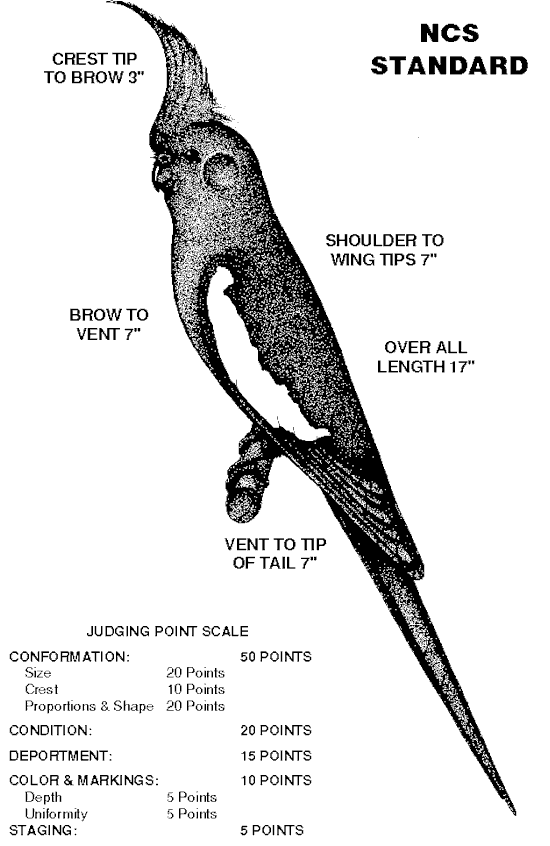
The NCS Standard envisions a long, graceful bird of good body substance and equal proportions. The cockatiel should measure 14 inches in length from the top of the crown to the tip of the tail. In addition, the crest should approach 3 inches in length. Proportionally, the bird should measure equally in length from: the top of the crown to the vent, the top of the shoulder to the tip of the wings, and from the vent to the tip of the tail.
The crest, as the cockatiel’s chief physical trademark, should be full and showy, curving back gracefully, with the longer filaments graduating evenly down towards the shorter ones at the rear of the skull. The head should be large and well-rounded without evidence of a "flat top" either behind the crest or at the back of the skull. The eyes should be large and bright, situated at mid-point between the front and back of the skull (with good width between) and sheltered by a pronounced frontal brow-line, creating a proud, "hawk like" appearance when viewed from the front. The bright orange cheek patches should be round, well colored, and free of "bleeding" extraneous orange feathers elsewhere on the face. The beak should be clean, tucked in and of normal length. The lower mandible should be only partly visible. The yellow face of adult males should be brightly colored and without extraneous grey or orange feathers (except for young males going through the molt) and clearly contrast where it meets the main body feathers. The bib should be deep. The neck, adding grace to the form, should be neither too long nor too short, and particularly evident when the bird is in an alert stance.
The cockatiel is a sleek, stream-lined bird, yet full-bodied, showing good substance. When viewed from the front (or back), a generous width across the chest and shoulders in adults (particularly hens) should be evident. The back should be straight, blending with the slender, tapering abdomen. The wings should be large and wide, held tightly, hugging the body with tips close to the tail, without crossing or drooping. All flight feathers should be present. The wing patch should approach ¾ of an inch in width and be clear of extraneous dark feathers.
Legs and feet should be clean, strong and firmly grasp the perch. All toes and claws should be present and nails should not be overgrown. The tail should be long, clean and straight, (lacking frayed, damaged or soiled feathers) and tightly whipped together, adding to the cockatiel’s elegant and graceful appearance.
CLASSIFICATIONS
Normals: The normal grey should be of an even and uniform depth of color, free of marbling or lighter areas. A consistency in overall tone is of more importance than depth of color. Birds sporting one or more yellow or white feathers on the head, nape, breast or other areas of the body (indicative of other color mutations in the recessive state) must be shown in the split class.
Cinnamons: A more pronounced brown shade (as when contrasted to normals) lacking any grey overtones, is preferred. A uniform depth of color, free from marbling (more common on the backs and wings of some males due to a loss of melanin pigment) is desirable. Some hens may have more yellow (lipochrome pigment) on the face thaN their normal grey counterparts. All other markings to be judged as normals.
Pearls: "Lacing" should be extensive, uniform and well defined, with enough grey for contrast and free from splotching or defects in pattern. Hens should carry the pearl lacing over the back, wings, mantle and nape, with a heavier concentration on the shoulder. Yellow or white flecking on the breast is not unusual on heavier marked pearls. Adult pearl males who retain some degree of their lacing will be preferred. The lacing should be of a true pearl design, rather than the light spotting of normal males in the ticked class.
Lutinos: The lutino is a white bird with an orange cheek patch, some yellow pigment, pink feet and red eyes. Some individuals vary with a light to heavy yellow wash over part or most of the body. Baldness occurring behind the crest, as an inherited trait, will be penalized in accordance to its degree (or rewarded for its absence). Ideally, there should be no bald spot.
Pied: The primary factor when judging pieds will be the degree of symmetry and clarity of markings over the actual percentage of pied wash. Ideally, a desirable pied will carry a clear mask, free from extraneous grey feathers of "bleeding" from the orange cheek patch, clear tail and wing flights and a perfect balance of markings. All things being equal, a light pied with perfect symmetry of markings would be preferred to a heavier pied with more irregular markings.
Albino: A completely white bird with red eyes and pink feet, lacking the orange cheek patch and devoid of all pigment. Currently rare in the U.S.
Fallow: A brownish (tan) appearance resembling the cinnamon, but with a more pronounced yellow suffusion and red eyes.
Silver: A "silvery-grey" to brownish bird with red eyes. Color differs between European and American stock.
White-face: "Charcoal grey" in color, lacking the orange cheek patch and yellow pigment. Mature adult males will carry a white face as opposed to the yellow mask worn by other varieties.
Cross Mutations: Cross or triple mutations will be judged according to each color standard they represent, then as a combination of both (or all) mutations.
Splits and Mutational Splits: All split birds will be entered in the section they visually represent i.e. a normal split pied will be entered in the normal section; a cinnamon split pied will be entered in the cinnamon section, etc.